Garden skills
Frost Protection: How to Stretch the Season a Few More Weeks
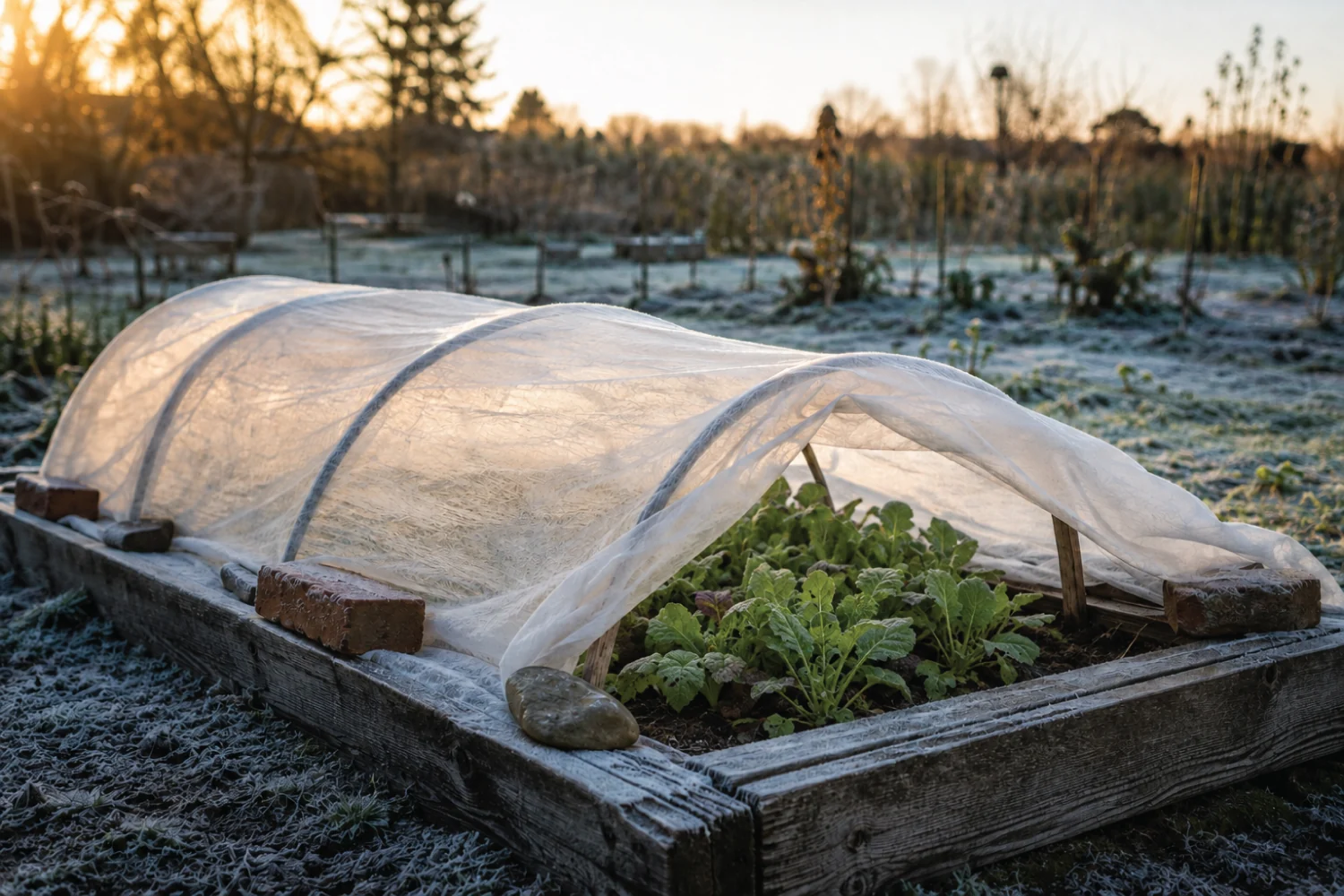
The first cold night of the fall almost never ends a garden. It just ends parts of it that couldn't take a cold night.
That distinction is worth saying, because the first one usually arrives well before the season is actually over. There are often weeks of decent growing weather on the other side, and a light sheet thrown over a bed for eight hours is frequently all that stands between the two.
The short answer: cover tender plants (basil, tomatoes, peppers, squash, beans) before dark with row cover or an old sheet, brought all the way to the ground and held off the leaves, then uncovered in the morning. Hardy plants like kale, carrots and parsnips need nothing, and several of them get sweeter for the cold.
What frost actually is
Frost forms when the surfaces in your garden lose heat to the open sky faster than the air replaces it. Which means the nights that produce it are the clear, still ones. Cloud cover holds heat in like a lid, and a bit of wind keeps mixing warmer air down. A cloudless, windless night after a bright day is the classic setup, and it's why you can wake up to white leaves when the thermometer on the porch never went below 34F.
It's also why frost lands unevenly. Low ground collects the cold air that drains off higher ground, so the bottom of a slope frosts first. Anything with a solid roof or a wall near it fares better than anything standing alone. The open middle of a lawn is the worst place to be.
It's also worth separating from a real freeze, which is different weather. A light frost is just a brush at the surface. A hard freeze is cold air sitting over you for hours, going deep enough into the soil that no bed sheet can do anything about it. Which means covers save you from the frost, but they can't stop a hard freeze.
Which plants need frost protection (and which don't)
This is what decides how much work you're actually in for, and it varies more than you'd think.
Some plants are finished by a single light frost. Basil is the extreme case: it has essentially no cold tolerance, and a few hours near freezing turns the leaves black by morning. Tomatoes, peppers, squash, cucumbers, beans and melons all end within a night or two of it.
Some are totally unbothered. Kale, cabbage, collards, leeks, Brussels sprouts, spinach, chard, and most of the root vegetables carry on through frosts that flatten everything around them.
Then there are those actively improved by it. Parsnips convert starch to sugar after sustained cold, which is where their whole flavor comes from. Carrots and beets sweeten in the ground. Cabbage and Brussels sprouts get noticeably better. Radicchio and endive lose their bitterness. For that group, the first frost isn't a threat at all, it's exactly what you've been waiting to happen.
Verna carries a frost sensitivity for every plant, on four levels rather than a hardy-or-not split, which is why a cold night produces a "harvest this now" step for one plant in your garden and nothing at all for the plant next to it.
How to cover plants for frost
A cover doesn't warm anything. Instead, it traps the heat the ground is already giving off, and stops that heat radiating away to the sky. It's that simple, and every rule below follows from it.
It has to reach the ground. A cover draped over the top of a plant and left open at the sides lets the warm air sneak out the bottom. Bring it all the way down and weigh the edges with rocks, bricks, or a length of board.
It shouldn't touch the leaves. Wherever the fabric rests on foliage, the cold comes through at that point and you get frost damage in the exact shape of the contact. Hoops, cages, stakes, an upturned tomato cage, anything that holds it a few inches clear are key.
Put it on before dark. The heat you're trying to keep is in the soil at sunset. Cover a bed at 10pm and most of it's already gone.
Take it off in the morning. Once the sun is up, an uncovered plant is happier, and a covered one can still cook faster than you'd think on a bright fall day. Lightweight row cover is the exception and can stay on, since light and water both pass through it.
Water the day before, if the soil is dry. Moist soil holds considerably more heat than dry soil and releases it more slowly overnight. It's the least effort for the most benefit on this whole list.
What to cover plants with: row cover, sheets, buckets
Lightweight row cover is the honest best answer. A 0.5 to 1 oz fabric holds roughly 2 to 4F, a medium 1 to 2 oz holds around 4 to 6F, and both let in light and rain so you can leave them on for a stretch of cold weather instead of doing it nightly. It's cheap, it lasts several seasons, and it doubles as insect protection in spring.
Old bed sheets and light blankets work fine for a single night. Heavier is warmer, but heavier also needs better support so it doesn't crush what's underneath.
Cardboard boxes and turned over buckets are excellent for individual plants and take ten seconds. Weigh them down.
Plastic sheeting is the one to be careful with. It holds heat, but it also conducts cold straight through wherever it touches a leaf, so it only works over a frame. And it has to come off first thing in the morning.
Cloches and cold frames are for the plants you're overwintering rather than for one bad night, and they're worth it if you're growing greens into the winter.
A few degrees sounds like almost nothing. In practice it's usually the difference between a bed that's finished and a bed that gives you another two or three weeks, because the first cold nights of fall tend to graze freezing rather than dive under it.
Sometimes the answer is a bucket and a walk
Covering isn't automatically the right call. For plants that were going to end soon anyway, picking is simpler and better.
Green tomatoes will color up indoors over one to two weeks, stem side down and out of direct sun. Peppers that have started to show any color will usually keep ripening on a counter; ones that are still solidly green mostly won't, and they're perfectly good used green. Basil should just be harvested, all of it, in one session, because it's not going to survive and it freezes and dries well.
If a plant is genuinely at the end of its productive run, the honest move is to bring in what's on it and give the bed to something else. There's more on reading that per plant here, and on what to pull and what to leave standing once it's done.
Which plants to bring indoors, and when
Some things come indoors instead, and they don't all come in at the same time. Rosemary can generally stay out until nights approach 30F. Marjoram wants to be in by about 40F. Aloe and lemongrass want to be indoors before nights drop below 50F, which is often weeks before any frost is in the conversation at all.
That's the useful thing to know: the trigger for moving pots is each plant's own number, and for several of them it arrives long before the first frost warning does.
Where Verna sits in this
The hard part of frost protection isn't the technique. It's knowing which night matters, and for what.
Verna works out your frost window from climate data at your actual coordinates rather than from a regional chart, and it carries each plant's own tolerance alongside it. So the guidance that comes out is plant by plant: a harvest-everything step for the ones a light frost ends, nothing at all for the ones it improves, and a bring-it-inside step for the ones that were never going to overwinter outside where you live.
Which is really the point. A frost date on a chart is one number for a whole region. What you need is a different answer for the basil, the kale and the rosemary, in your garden. There's more on why a single date was never the right shape for that question here.
And if you garden somewhere hot, most of this is somebody else's problem and your year is pointing the other way entirely.
The short version
Cover before dark, all the way to the ground, off the leaves, off again in the morning. Water first if it's dry. Cover the tender things and leave the hardy ones alone, because a lot of them are better for the cold. And when a plant is nearly done anyway, pick it instead of protecting it.
The first frost is rarely the last day of the garden. It's just the day you start winding down to it.
Quick questions
How cold is too cold for my plants?
It depends entirely on the plant, which is why one number was never going to work. Basil, tomatoes, peppers and squash are finished by a first light frost right around 32F. Kale, carrots, parsnips and leeks carry on well below that, and several of them taste better for it. Worth knowing that frost can form when the air reads 34 to 36F, because the leaf surface gets colder than the thermometer on the porch.
Will a bed sheet actually protect plants from frost?
For a light frost, yes. A sheet works by trapping the heat the ground is still giving off, so it has to come all the way down to the ground and be held off the foliage, and it needs to go on before dark while that heat is still there. That's worth a few degrees, which is usually enough. A hard freeze is different weather and a sheet won't argue with it.
Do I have to cover my vegetables every night now?
No, and most people cover far more often than they need to. The first cold nights of fall tend to graze freezing and are often followed by a warm stretch, so it's usually a handful of nights rather than a new nightly chore. Lightweight row cover can stay on through a cold spell since light and rain pass through it. And for anything nearly finished anyway, picking it is simpler than protecting it.
Know which night actually matters
Verna reads the climate at your coordinates and carries each plant's own frost tolerance.


Get garden notes in your inbox
Short seasonal notes from Verna on what to plant and do. No spam, and you can unsubscribe anytime.
You're subscribed. See you in the garden.