Seasonal guide
What to Plant in August for a Fall Harvest
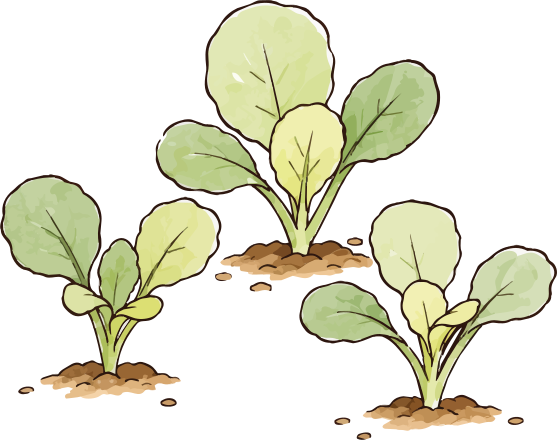
There is a particular kind of August sadness that gardeners talk themselves into. The beds look tired, the lettuce bolted weeks ago, something has eaten the chard, and the whole thing starts to feel like a season that is winding down. So the tools go in the shed a little earlier every year.
It is worth resisting, because August is not really the end of anything. In most temperate gardens it is the start of the fall season, and the fall season is quietly one of the best ones. Fewer pests. Less watering. Cool nights that make greens and roots taste better than they ever do in June. The catch is that the planting has to happen now, in the heat, while it still feels like summer. Fall gardens are built in August by people who are sweating.
The quick version: August is for plants that grow fast and don't mind a chill. Arugula, mustard greens, leaf lettuce, spinach and radishes can finish in three to six weeks; turnips, kohlrabi, bok choy and chard need six to nine; carrots want longer but improve with the cold. Whether each one fits depends on your local climate.
What to plant in August: fast and cold-tolerant
The plants worth reaching for in August share two traits: they grow fast, and they do not mind a chill. That combination is what lets them finish while the weather cools instead of racing the weather.
The fast greens are the easiest win. Arugula, mustard greens, leaf lettuce, and spinach can go from seed to something you would actually eat in roughly three to six weeks. Radishes are faster still. They are cheap to try, they take up little room, and if a sowing fails in the heat you have lost a few weeks and a pinch of seed.
The quick roots and sturdy greens come next. Turnips, kohlrabi, bok choy, and Swiss chard tend to need somewhere in the range of six to nine weeks, and they hold well once they are up. Carrots want a bit longer, closer to two to three months, and they are famously one of the plants most improved by cold weather.
Then there are the plants that need the most runway. Kale, cabbage, and broccoli are slower, and in cooler regions August is often the tail end of their window rather than the middle of it. If you have transplants ready rather than seed, that changes the math considerably, because you are skipping the first few weeks.
And a few things planted in August are not for this year at all. Garlic and spring bulbs go in later in fall, but August is when you order them, while the good varieties are still in stock.
How to tell if there's still time where you garden
Here is where most August planting guides quietly fall apart. Every list like the one above, including this one, assumes a "typical" fall. But the useful question is not "what can be planted in August." It is "does this particular plant still have enough good season left in the specific place I garden."
Those are different questions, and only the second one has a real answer. A gardener in the upper Midwest and a gardener on the Gulf Coast are both reading "plant kale in August," and only one of them is getting good advice. Even within a single town, a garden on a south-facing slope and one in a low frost pocket are not running the same clock.
The traditional fix is to look up an average frost date, count backward by days to maturity, add some padding, and hope. It is finicky work built on a shaky foundation, since that date was only ever an average to begin with. Which is exactly the chore Verna takes off your hands. It starts from the climate data for your location rather than a distant station, reads each plant's own biology, and works out whether the window is genuinely open for that plant, in your spot, right now. If you know your garden runs warmer or cooler than the neighborhood, you can tell it, and it adjusts.
What August means in a hot climate
August advice written for a northern garden can be actively misleading in a hot, dry climate. In the desert Southwest, much of Texas and the Gulf, and the warmer parts of California and Florida, midsummer is the hard season, not the good one, and fall through spring is prime. The full shape of the warm-climate year is here. In those places August is often less about squeezing in a last planting and more about the starting line coming into view. The cool-season window is opening rather than closing, and the calendar effectively flips. If that is your climate, the honest version of "what to plant in August" is "sooner than you think, and Verna will tell you when."
How to get seeds up in August heat
Seeds sown now are germinating in hot, dry soil, which is the real difficulty. Sow a little deeper than you would in spring so the seed sits in cooler, moister ground. Keep the top inch consistently damp, which in a hot week can mean a light watering twice a day until the seedlings are up. And consider shading the row with a board, a piece of burlap, or a scrap of shade cloth for those first few days. The full toolkit for summer germination is here.
None of it is complicated. It is just a different set of habits than spring asks for, and August is one of the few times of year when both sets are needed at once.
The honest closing thought
You do not need to squeeze every last thing into the ground this month. A single short row of something fast is a perfectly good August. The point is only that the season is not over, it has simply changed direction, and the gardens that eat well in October are the ones that noticed in August. When the month turns, the September version of this question has its own answer.
Quick questions
Is August too late to start a garden?
No. In most temperate gardens August is the start of the fall season, and fall growing comes with fewer pests, less watering, and cool nights that sweeten greens and roots. The catch is that the sowing has to happen now, in the heat, and the fast, cold-tolerant plants are the ones that fit.
What vegetables can I still plant in August?
The fast greens first: arugula, mustard greens, leaf lettuce, spinach and radishes. Then turnips, kohlrabi, bok choy and Swiss chard, which hold well once up. Kale, cabbage and broccoli are at the tail of their window in cooler regions unless you have transplants, which skip the slowest weeks.
Why won't my seeds germinate in August?
Hot, dry soil. The surface dries within hours and crusts over, and some cool-season seed, lettuce especially, stops germinating in warm soil altogether. Sow a little deeper than in spring, keep the top inch damp until seedlings appear, and shade the row for the first few days.
See what still has time in your garden
Verna maps sowing, transplanting, and harvest timing to your exact spot.


Get garden notes in your inbox
Short seasonal notes from Verna on what to plant and do. No spam, and you can unsubscribe anytime.
You're subscribed. See you in the garden.